

I sit quietly in front of my students at the start of every meditation session, and this is where the idea for this article came to me.
I watch the students settle. I hear their breathing soften. There is a particular energy in that moment—not yet meditation, but not nothing, either—and it kept pulling at me until I understood what it was.
We call it a “meditation session.” But in that first moment, none of us are actually meditating. Not yet.
Where meditation actually sits
If you follow the eight limbs of Yoga, this becomes easy to locate. Generic English uses one word, “meditation,” to cover two different limbs: dharana, the sixth limb, and dhyana, the seventh.
Dharana is intentional, one-pointed concentration—effortful, still gathering itself. Dhyana is what arises once that concentration stabilizes: continuous, effortless, no longer something you’re doing but something that is simply happening.
Neither of these is where you are the moment you sit down. So when a class begins with an affirmation like “I am becoming calm, I am becoming present“—reaching straight for dhyana, or even dharana—you’re asking students to affirm a state that may still be quite far from where they actually are. It is a stretch goal dressed up as a starting instruction.
I want to propose something different: Start from where you are.
There’s a practical reason for this, beyond the philosophical one. If you keep your eyes fixed on dhyana—the ultimate dissolution, the state where effort disappears entirely—you’re staring at something that’s genuinely far away. Session after session, you reach for it and don’t arrive. That’s not a small thing. It breeds frustration, and frustration isn’t a realistic place to build a practice from.
A list of small, already-achieved things does the opposite: It gives you something true to stand on, right now, and a quiet sense of “I’m getting somewhere” instead of “I’m not there yet.” That felt sense of down-to-earth positivity isn’t decoration—it’s what keeps you sitting down the next day.
What have you already done?
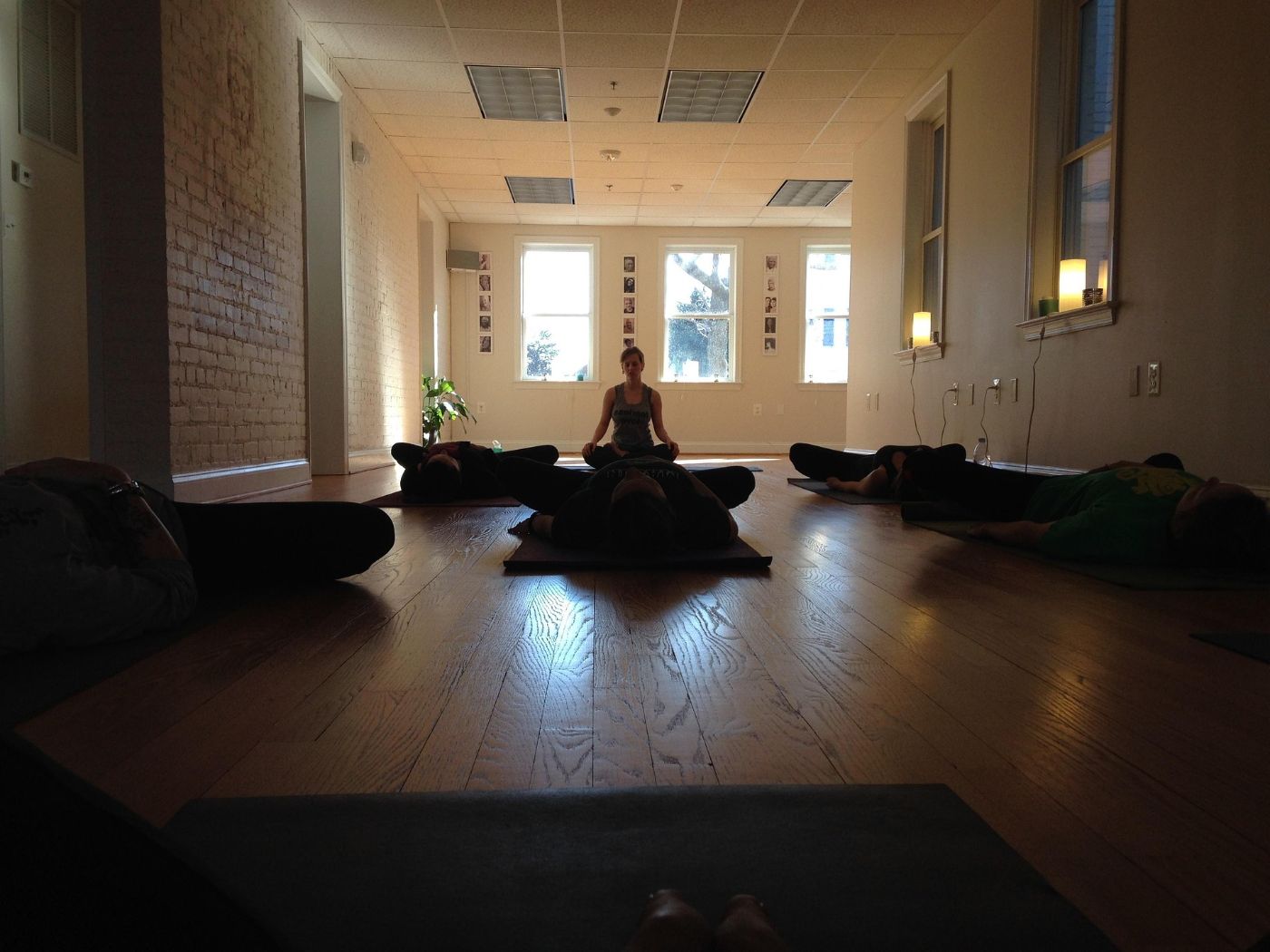
Think about what has actually been gained. You finished postural practice. Some of you are lying on your backs, some are seated. Ask yourself—what have you already achieved, right now in this very moment, that you haven’t given yourself credit for?
Here is why I say this with confidence. I watch it happen every time. Your limbs, which were moving a minute ago, are now still. Your eyes, which were open and looking—maybe aimlessly—around the room, are now closed. Your mouth, which was talking to the person on the mat beside you, is now quiet.
You may not see the significance of this. But this is pratyahara—the fifth limb, sense withdrawal, the step that comes directly before dharana. You’re already turning inward.
My job, at this moment, isn’t to push you towards some distant concentrated state. It’s to point at what you’ve already done and say: notice this. Acknowledging it feeds the very energy that carries you forward into concentration.
If you skip this acknowledgment, there’s another path close by—you might simply fall asleep. You’ll think you were meditating. You weren’t. There’s no blame in that—you got a good rest, and rest has its own value. But it happens partly because the definition of meditation was never made clear to you. You didn’t have the map, so you took the nearest exit.
This is worth sitting with, because the Buddha himself said meditation isn’t the only road to awakening. Knowledge—paññā, direct understanding—can get you there on its own. Knowing precisely where you stand on the path isn’t a side detail. It is, itself, the major part of the practice.
Building a list of small steps
So here is what I ask my students to do the instant they enter a session—before reaching for any big goal, build a small list and start ticking the items off:
- I’m looking around.
- I’m not moving around—I’m not busy.
- I’m not talking.
- I’m not touching my hair.
- I’m not reaching for my phone.
- I’m not straining or restraining my breath.
Keep going. Let the list build itself.
There’s a word in the Buddhist tradition for exactly this kind of act: sati, usually translated as “mindfulness,” but the older, more literal sense of the word is “recollection” or “remembering.” Not remembering the past, but remembering to notice what is already true right now, in front of you—which you would otherwise walk straight past.
The checklist is sati in its simplest form. You aren’t manufacturing calm; you’re recollecting the calm that has already arrived, one small tick at a time.
Start with reality—not fantasy
Start there with the reality, not the fantasy. Not at the summit, but at the step you’ve already taken. Staring up at a peak you can’t yet touch will only tell you how far you have to go. Ticking off what you’ve already done tells you something truer and kinder: that you’re already moving.
«RELATED READ» A PRACTICE THAT TOUCHES VIPASSANA, SAMADHI AND SAMATHA: By using nothing but a piano piece»
image: 532Yoga