

For many years, I’ve watched people arrive at my art workshops carrying the visible signs of busy lives. They often apologize before they even begin. They use statements like:
- “I’m not artistic.”
- “I haven’t done anything creative in years.”
- “I’m terrible at drawing.”
Then I give them a pen or a pencil. Not a complicated set of art supplies. Just a pen and a small piece of paper.
I ask them to make one simple mark or line, then another, and then something changes. Conversations slow down and people stop looking around the room to see what everyone else is doing. Their attention begins to settle on the small movement of their own pen. There is nothing particularly impressive about the marks themselves, and that’s precisely the point.
Creativity’s not about the outcome
I came to this practice through my work as an artist and mindfulness facilitator. For more than a decade, I’ve explored the relationship between repetitive mark-making, creativity and being present.
My work with pointillism had already taught me something about repetition. A painting can be built from thousands of tiny dots. One dot seems insignificant. Put enough of them together and something begins to emerge.
Over time, I became interested in what happens when we remove the pressure to create something impressive.
What if the dots don’t have to become a painting, or what if the drawing doesn’t have to be beautiful?
This question eventually became important to me because so much of our daily lives are organized around outcomes. We finish tasks. We meet deadlines. We answer messages. We measure progress. Even activities that are supposed to help us relax can become another thing to accomplish.
Mindfulness can easily become another item on the list.
But a repetitive drawing has no particular destination.
You make a mark.
Then you make another.
You notice the movement of your hand. You notice the pressure of the pen. Perhaps you notice your breathing. Perhaps you notice that your mind has wandered, which is totally fine.
The mind doesn’t have to be totally quiet
One of the things I’ve learned from facilitating these activities is that people sometimes have an unrealistic idea of what mindfulness should feel like.
They expect their thoughts to disappear or to feel immediately peaceful. They may think that if their mind is still busy, they’re doing it wrong, but a busy mind isn’t a failure.
When we draw repetitive patterns, thoughts still come and go. We may remember something we forgot to do. We may start planning tomorrow. We may hear a noise outside the room.
This is the key; the invitation is not to stop thinking.
It’s simply to notice when we’ve wandered and gently return. Return to the line, return to the dot and then return to the next small mark.
Why I created a little box of calmness
Eventually, I wanted to make this experience available beyond the in-person or virtual workshops I facilitate.
I began thinking about what would happen if someone could take the experience home, not as an art project to complete, but as a small invitation to pause.
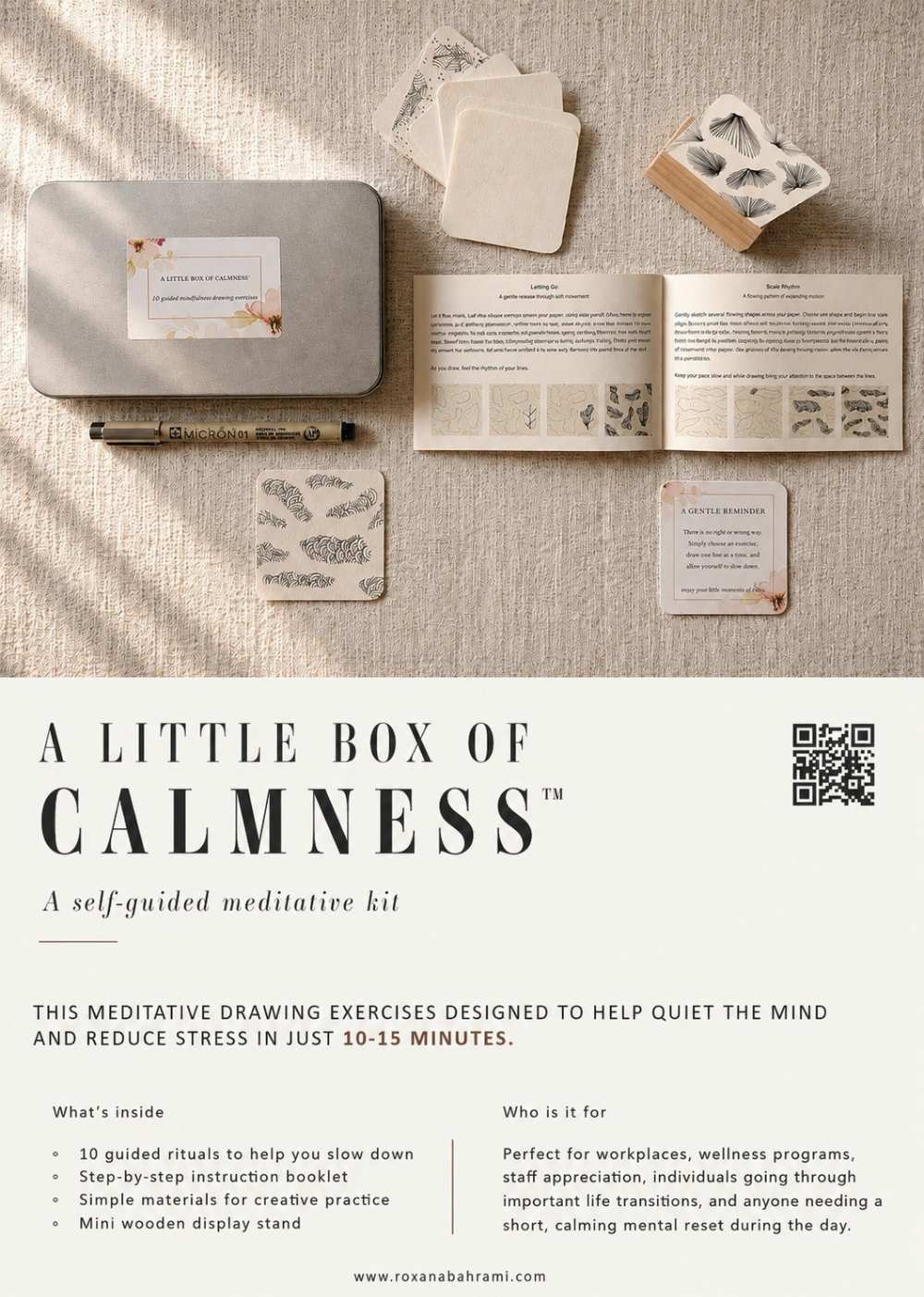
That idea became A Little Box of Calmness™.
The contents are intentionally simple. There is no elaborate collection of materials and no expectation that the person using it will produce a finished work of art.
Instead, the emphasis is on slow, repetitive drawing with a single pen and pencil.
I wanted the box to remove some of the decisions that can get in the way of beginning, such as: “What should I draw? Do I need to be creative? What supplies do I need, and most importantly, what will this become?”
None of those questions are particularly useful when the goal is simply being in the moment.
The value of slow, repetitive movements
We live in a culture that often asks us to justify how we spend our time. If we exercise, we’re improving our health. If we take a course, we’re developing a skill, and if we read, we’re learning.
But there is something wonderful and freeing about doing an activity that doesn’t have to produce a specific piece.
A repetitive drawing can be completely unnecessary. It doesn’t have to become a card, a painting or a gift. Even though, in some cases, it can be!
It can simply be 15 minutes during which you sit somewhere and make marks, instead of going though your mobile device.
I’ve come to think that insignificant moments aren’t necessarily unimportant ones.
A life is made up of small moments, and our attention is constantly being pulled away from them. We look at screens while eating. We listen to podcasts while walking. We answer emails while drinking coffee.
We’re rarely asked to do just one thing. Come to think of it, repetitive drawing offers a very small rebellion against that habit.
For a few minutes, there is only one thing to focus on, and that is repetitive drawing.
A practice small enough to begin
I don’t think mindfulness needs to look the same for everyone.
For some people, it may be sitting quietly and following the breath. For others, it might be walking, gardening, cooking or paying close attention to a familiar daily ritual.
For me, and for many of the people I’ve worked with, making repetitive marks offers another doorway.
You don’t have to consider yourself an artist. You don’t have to know how to draw. You don’t have to clear your schedule for an hour.
It’s accessible because you don’t have to consider yourself an artist. You don’t have to know how to draw. You don’t have to clear your schedule for an hour. You don’t even have to feel calm before you begin.
You can begin exactly as you are. Just take a piece of paper, pick up a pen, make one small mark, notice it and then make another. At the beginning, your mind may wander. That’s OK. Notice it and try to return to make another line.
There is no finished picture waiting at the end to tell you whether you’ve succeeded. The practice is in the returning.
And perhaps that is what I have come to appreciate most about these small, repetitive drawings: They remind us that being present doesn’t have to be complicated.
Sometimes, all we need is one small thing to pay attention to. One mark, and then the next.
«RELATED READ» WHAT THE PIANO TAUGHT ME: 3 life lessons learned during my first few months of practice»
image 1: sunbeamphoto; image 2: Roxana Bahrami