
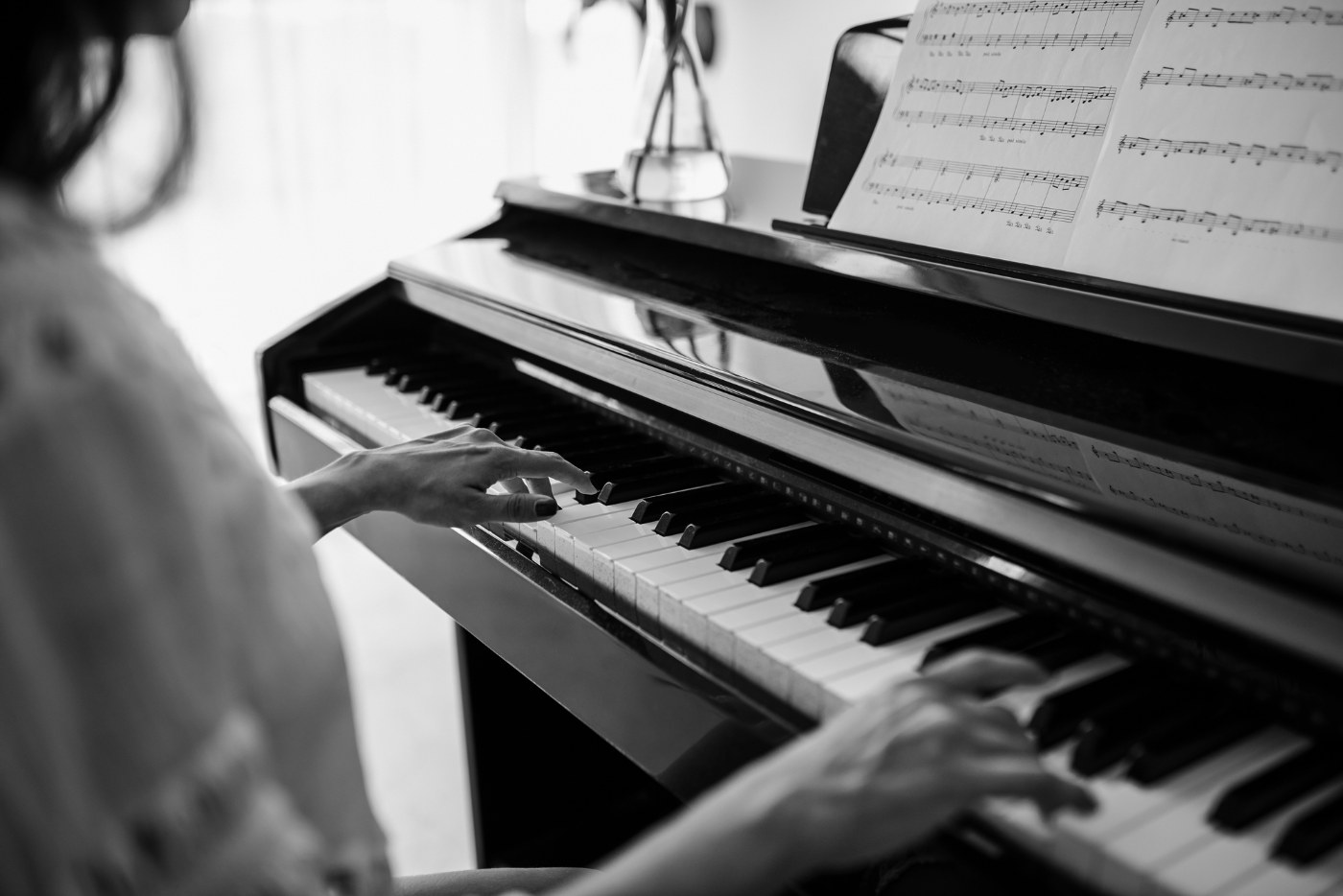

I can play “Happy Birthday.” I can play “Jingle Bells” and I know what the word pianissimo means. Most importantly of all, I now know the importance and power of daily practice, and that goes for any skill. I’ve seen the beautiful results of letting yourself be terrible and incompetent and continuing to try anyway.
Six months ago, I started taking piano lessons. I’ve practiced for half an hour, six days a week since I had my first lesson and acquired a piano on the same day. At this point, I can acknowledge that I’m no 9-year-old piano prodigy, but I have a much larger repertoire of songs I can usually play well than I thought I would have by now. I’m so pleased with myself, and starting out, I was so frustrated.
I’ve had severe performance anxiety for as long as I can remember, so everything had to align for me to leave my comfort zone in this way. Thank God I did, because the experience has taught me the life lessons I needed to overcome perfectionism and self-criticism, two genuinely impairing obstacles to self-improvement.
In the past, I feared and disdained mistakes, and expectations were unachievably high for first drafts and initial sketches. In a nutshell, learning to play the piano showed me that failure and mistakes are part of a beautiful process of skill-development, and that daily practice (with patient persistence!) is transformative.
A Dhamma friend once described her lax approach to life, and ended her thought with words that have stuck with me since. “But it would be worse to be a perfectionist. They can’t even start.”
At the time, I thought to myself, “That is so true, I can’t even start and it’s the worst.”
Every inadequacy I detect in myself feels devastatingly significant, and in the past, I’d approach creative acts (and the rest of my life) fearfully because of it. Mindfulness practice has given me greater control over my headspace, but years of mental lashings seemed to have trained me to avoid risk and fear failure on a deeper level than just conscious thought.
Luckily, the Canadian public education system gave me a gift that carried me to piano lessons. I learned to play the trumpet in middle school and discovered that I could excel simply by being the only person to actually practice my instrument daily.
I drew my courage and motivation from that experience, knowing I’d soon be a better piano player than 99.9 percent of the population by simply practicing daily—no talent necessary. I struggled even more than I expected in the beginning, and yet, this has still proven true.
Daily practice reduces discomfort
Daily practice is all it takes to set you apart. But how many people practice anything daily?
I’ve been diagnosed with ADHD, so I expected certain aspects of playing the piano to be particularly difficult for me, such as keeping time and memorization. However, the biggest challenge ended up being my poor hand-eye coordination and motor control, a minor deficiency in my daily life: I can’t hold chopsticks correctly for more than a few seconds without “losing it,” and I was the only person in a Zumba class who was constantly dancing backwards, unable to mirror the instructor.
The last word anyone would use to describe me is “graceful,” and I’ve never felt that lack more intensely than during piano lessons.
My piano teacher, Alissa, is an easygoing young woman who’s accustomed to teaching young children to play instruments, armed with light-hearted patience and a soothing white cat named Tyra. She was totally non-judgmental, yet I felt a deep pang of embarrassment with every witnessed mistake.
The discomfort I sometimes felt during lessons was totally unanticipated and was certainly coming from within, making me realize how deeply engrained self-judgment and a fear of failure are in my psyche. There were times during lessons during which I felt strong emotions or was internally overwhelmed. I leaned on mindfulness skills in those moments, reminding myself to just be present and relax.
Over time, I became less anxious and embarrassed by mistakes, and more able to check my ego at the door. Throughout the weeks I’ve taken lessons, I also learned three more specific lessons about practicing any skill—and about life itself—which I’ll describe below.
Don’t expect perfection on the first try
Every lesson, I’d struggle with a new concept or song in front of my teacher, and I’d leave feeling a bit baffled and stumped. Without fail, by the time I returned a week later, I’d magically have sorted myself out and gotten the hang of it, with only minor adjustments needed.
Of course, the magic was in persistent practice. It took multiple sessions of practice over the course of days to really grasp basic techniques and songs in the beginning, and the first few sessions with a new song could be frustrating and feel fruitless. But the fruit would come just a few days later.
Trying repeatedly and messing up a lot is a normal part of the creative process on the piano, but also with any instrument and any artistic medium. It’s a normal part of developing any skill, and you’ve got to be willing to be incompetent in the beginning if you want to get any better.
I’m an occasional visual artist, and when I set out to draw, I used to judge initial sketches harshly. I expected each one to be good enough to be the final product from the get-go. Since learning to play the piano, though, I’ve discovered that expecting to do multiple practice sketches and take multiple sessions to create a “final product” results in a much more enjoyable creative experience—with better drawings to boot.
Expert visual artists know how to take advantage of repeated efforts, and they reap the benefits of mundane practice by doing drawing studies and daily sketches. Seeing how improvement accumulates over days, as I practiced the piano, has also adjusted my expectations and creative process as a novice artist.
As a writer, I knew all about drafts and the revision process, but I wasn’t practicing my craft daily or polishing pieces that I knew wouldn’t see the light of day. I’ve realized, however, that if I don‘t put the time and effort into improving my craft, my work won’t ever be read. Certainly not consistently.
Things that seem fruitless eventually bear fruit
Real improvement happens as a result of persistent effort applied over the course of multiple days. In these conditions, I’ve noticed that my piano playing skills seem to improve overnight, because I can always play a song I’ve been working on better at the start of a session than I could by the end of the session the day before. This may be due to the process of memory consolidation that happens in our sleep.
One amazing aspect of learning to play the piano has been the improvement I’ve seen in my motor control and dexterity. Amazingly, I can play the piano gracefully now. I wasn’t taught to play gracefully; I’ve just gotten better at controlling my hands by using them while practicing each day. I’ve developed such confidence in my abilities that I bought an acoustic guitar, and I’ve been teaching myself to play that, too.
Improvement inevitably comes with practice
Spending half an hour practicing piano and half an hour on the guitar most days has become a medicine. Just like a daily meditation session, focusing my attention on that soothing mental and physical activity for an hour—instead of the flow of worries and ruminations that would otherwise travel through my brain—leaves me peaceful and relaxed. I don’t need self-discipline to keep up with practice at this point, because I do it to unwind.
Feeling relaxed by practice, rather than frustrated and brimming with self-judgment, took exposure to the truth of things: Practice will inevitably result in improvement, and no pressure or striving is necessary. It can be terrible, ugly practice, during which you don’t really “get it,” but there must be practice. Without it, there will be no improvement. With it, you’ll see huge improvements in mere days.
Your piano is waiting for you—go play!
If you enjoy practicing a skill, an art form or a craft of any kind, I’m convinced that you should practice as often as your schedule allows, in the small sessions that are necessary to make your practice a viable routine habit.
After quitting social media, I had more free time and had to fill it, or else I’d get bored and lonely. My creative side has flourished as a result.
Life is short, and it can be enriched with challenging and satisfying pursuits, or your precious time can be whittled away and wasted. I once was too fearful of failure and embarrassment to try anything new, and I’m so grateful the piano showed me the light.
I decided to return to university full-time in September to focus on writing and see where it takes me. I have no gift for piano, and yet I improved so much in six months, I began to wonder about my potential elsewhere. A newfound optimism, a loosened grip on perfection and faith in my ability to persist through difficulty has opened a door I’d planned to leave shut.
In the words of the Buddhist nun Pema Chodron, “fail, fail again, fail better.” Set a timer for 30 minutes, practice whatever skill speaks to you, hope you can make time for it again tomorrow, and see yourself grow.
Your piano is waiting for you. Go play! I promise it’ll be worthwhile.
«RELATED READ» A PRACTICE THAT TOUCHES VIPASSANA, SAMADHI AND SAMATHA: By using nothing but a piano piece»
images: Depositphotos