
Most people who journal for a while notice something odd. They sit down to write about one thing, such as a hard conversation, a life decision or a restless mood, and somewhere in the second paragraph, the same question appears again and again.
Why am I not enough yet? Why does this keep happening? Why do I always end up as the one who holds everything together? The wording changes from week to week, but the question underneath is familiar, and it arrives without being invited.
Most of us treat this as a sign that the journaling isn’t working. We feel stuck, we close the notebook and we try a different technique. But what if the returning question is the most useful thing on the page?
A meditation you can carry in a bag
Meditation asks for a quiet room, a cushion and a stretch of time that many of us don’t have. Guided journaling asks for a pen, a few minutes and a single prompt. It can happen on a train, in a parked car or at a kitchen table before anyone else is awake. Because the practice lives on paper, it also leaves a trace. A silent sit is gone when it ends, but a page can be read again.
That second quality is what makes journaling a different kind of mindfulness practice. During a sitting practice, we watch thoughts arrive and leave. In writing, we can watch certain thoughts arrive again and again. Attention commits these thoughts to our memory.
The mind loves an explanation
When something in our life repeats, the mind can’t tolerate not knowing why. Uncertainty is uncomfortable, so it fills the gap with an interpretation. For instance, I might think, she’s distant because of something I said, or I keep choosing this because I’m not worthy of better.
This always happens at work because of my boss. These explanations arrive fast and feel like understanding, but they’re often filters, a story laid over an experience that we then mistake for the experience itself.
Journaling can quietly feed this habit. We write the story, we reread the story and the story grows more convincing. This is why so many people say they understood a particular pattern in their life years ago, and yet, it’s still here.
Unfortunately, understanding that comes from interpretation tends to fade. It explains, but it doesn’t move or change anything.
A guided practice works differently when the prompt asks us to describe, rather than explain. What happened, in plain words? What did I feel in my body? What did I do next? Description keeps us close to the experience. Explanation takes us away from it.
The question as a messenger
Here is a way of looking at the returning question that changes how it feels:
First, keep in mind that a repeating pattern isn’t a malfunction. It’s a gap between the life you’re living and the life you could live, and that gap is trying to tell you something real. The question that keeps surfacing in your writing is often the voice of that gap.
Notice that this process is different from trying to get rid of the question. Many of us respond to a recurring thought the way we’d respond to a recurring pain—by looking for the quickest way to stop it. Yet, a pattern that is pushed away tends to come back wearing a different outfit. The same fear shows up in a new relationship, a new job, a new city.
A gentler approach is to treat the question as something that has a job. Ask it what it is pointing at.
Often, the answer isn’t dramatic. It’s something like: You’ve been measuring yourself against a standard that has no finish line or you’ve been giving in a way that never lets you receive.
A 5-minute writing practice to try
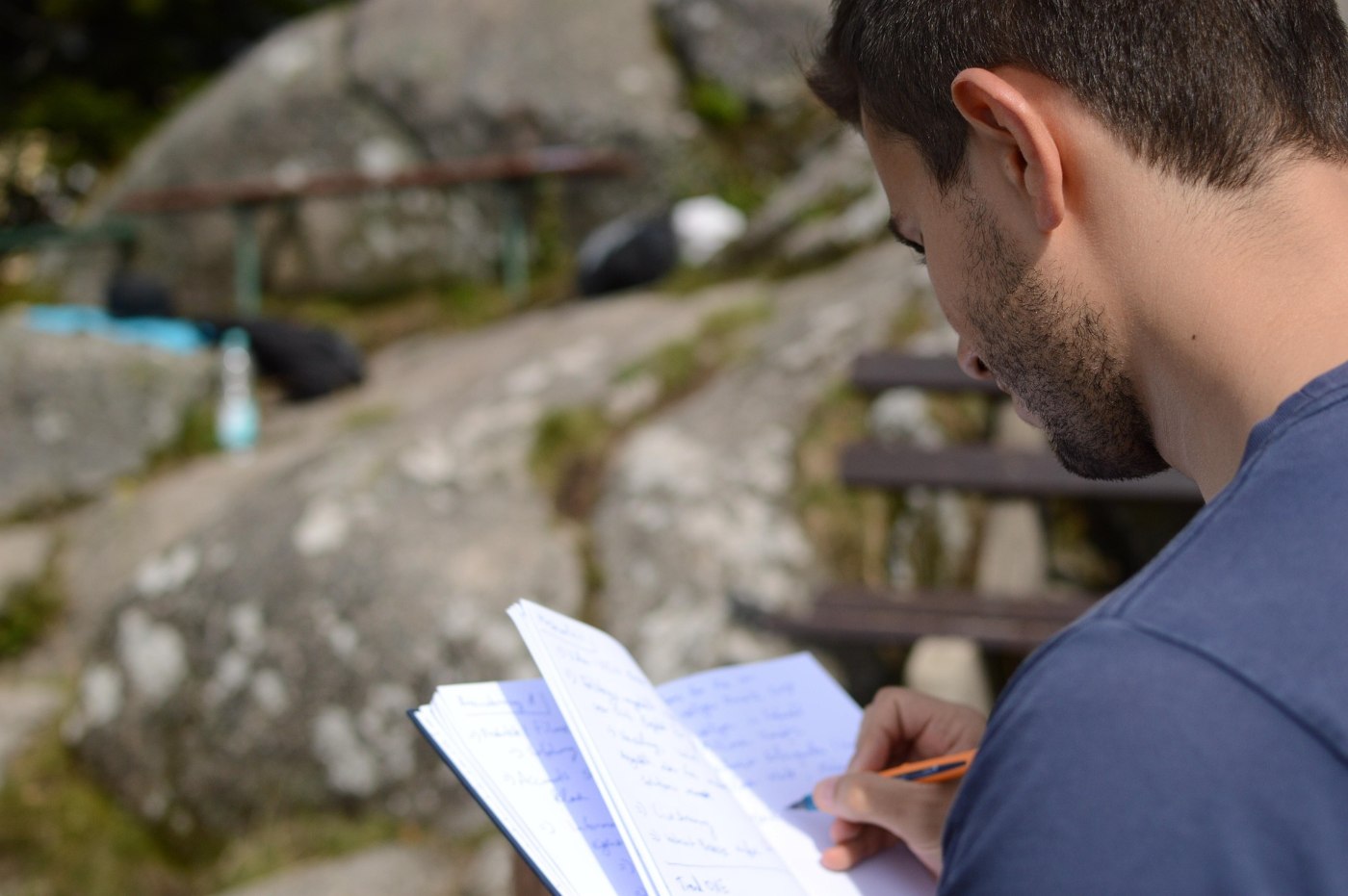
For this practice, you’ll need a notebook, a timer and an honest willingness to be a little curious.
- Write for two minutes without a topic. Let whatever is on your mind go onto the page, unedited and unfinished.
- Read it once, slowly, and underline any sentence that is a question, especially one that sounds familiar. If you keep a journal, flip back a few pages and see whether the same question lives there, too.
- Choose one question and write it at the top of a fresh page. Don’t answer it yet.
- Spend two minutes describing, not explaining. Ask yourself, “When did I last feel this question in my body? Where was I? What was I doing?” Limit this description to what you could see and feel.
- End by writing one sentence that starts with “This question might be pointing to…” and leave it unfinished if it wants to stay unfinished.
- Notice what happens when you don’t try to resolve the question. There is often a small loosening and the feeling of having been heard, rather than fixed. That is the meditative part. You aren’t changing anything. You’re sitting with something that has been asking for attention for a long time.
What to expect—and what not to
It would be easy to promise that a few days of this will dissolve a lifelong pattern. It won’t, and no honest practice can promise that. What it can do is shift your relationship to the pattern. A question you used to hear as an accusation can begin to sound like a clue.
You may also find that, some days, the page feels flat. That is part of the practice, too. The question will still be there tomorrow, and it’s not in a hurry. The invitation is to stay curious, to keep the pen moving and to resist the urge to wrap things up neatly.
Over time, many people find that the quality of their attention changes. They catch the old question a little earlier—sometimes, before it has taken over the whole afternoon. They begin to notice where the story starts and where the experience ends. This is mindfulness in its plainest form, and it needs no special room.
An invitation to go deeper
This week, you can try taking one question that has appeared in your writing more than once, and give it a page of its own. You might ask a friend or a journaling partner to do the same, and compare what each of you found—not to analyze one another, but to hear how different the same kind of question can sound in another voice.
What is the question you keep returning to, and what might it be trying to show you?
«RELATED READ» WORKING WITH LIFE’S PATTERNS: The difference between understanding and interpretation»
image: OrcaTec