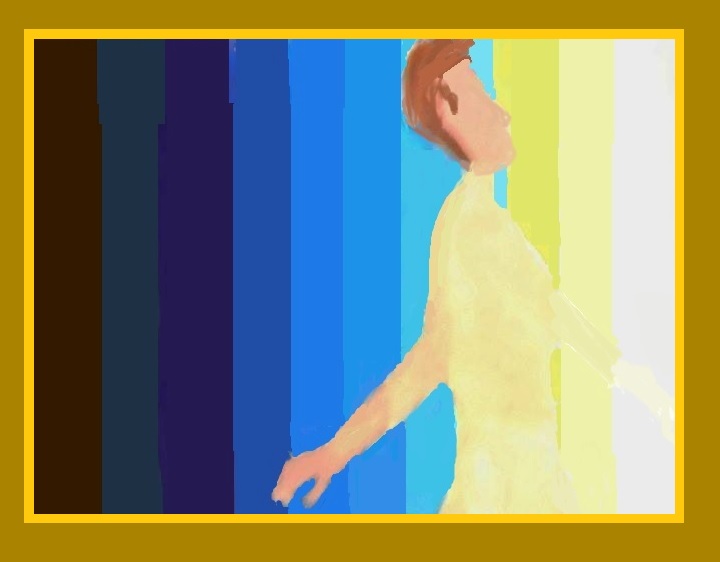

I remember the office afternoons more clearly than most of my achievements.
I’d sit at my desk, staring at Facebook, waiting for an email to arrive. Not working, exactly. Pretending to. Feeling useless and anxious, with the constant sense that I was wasting my life while looking busy.
Outside, the mountains were visible from the window. My whole body was asking to go for a run, to walk up a trail, to do something real with my legs and lungs.
And I stayed in the chair. Because that’s what adults do. Because work is how you survive. Because, if you can’t sit for eight hours, there must be something wrong with you.
For years, I believed that last part.
When you think the problem is you
I was an engineer, and a good one. I worked on demanding projects, from green hydrogen systems to the first electric car to race the Dakar Rally.
On the outside, I was doing well. On the inside, I was convinced I wasn’t built for the real world. If I couldn’t handle sitting still in front of a screen all day, I told myself, it was because I was weak, lazy or broken.
My self-esteem was terrible for a long time because of it. I’m no good at living, I thought. I’ll never be able to support myself. Everyone else manages this. Why can’t I?
It took a burnout, and a much deeper personal crisis, for me to see things differently.
The body was right
What I eventually understood was simple. The problem wasn’t me. My body was telling the truth.
Human beings didn’t evolve to sit in chairs under artificial light, waiting for messages. We evolved to move, to make effort when there’s a reason for it, and to rest when the effort is done. That restlessness in the afternoons wasn’t a defect. It was the most honest part of me, trying to get my attention.
And the thing that kept me in the chair wasn’t really work. It was fear. Fear of what would happen if I stepped off the expected path. Fear of the cold outside. The modern working world rarely needs to force anyone. Fear does the job.
The twisted thing about fear is that the more you run from it, the more it settles in. I ran a lot. I worked harder, took on bigger projects, said yes to the impossible. None of it made the afternoons feel any less empty.
Listening instead of overriding
I don’t work in an office any more. I live in a small village in the Pyrenees, and I work as little as I can. I know that’s not possible for everyone, and I’m not suggesting that anyone should quit their job tomorrow.
But I think there is something almost everyone can do, wherever they are: start listening to the body instead of overriding it.
When the restlessness comes, notice it before reaching for the phone. Ask what it wants. Often, it’s something very small: to stand up, to go outside for five minutes, to look at something far away instead of something close. When it’s possible, give it that. When it isn’t, at least don’t call it a weakness.
Mindfulness, for me, began there. Not on a cushion, but in that chair, slowly realizing that the voice saying “go outside” had been right all along.
A small experiment
If you spend your days at a desk, try this for a week. Each time the restlessness rises, don’t reach for the phone and don’t push it down. Pause for three breaths and ask your body what it’s asking for. Then, if you can, do the smallest version of it: stand up, stretch, walk to a window, step outside for two minutes. Notice how the rest of the afternoon feels.
You may discover, as I did, that the restlessness isn’t the enemy of your work. It’s a messenger. And the message is usually kinder than the voice that’s telling you to stay put.
What I’d tell my younger self

If I could sit next to that younger version of me, refreshing his inbox in the late afternoon light, I wouldn’t give him a productivity tip. I’d tell him that nothing is wrong with him. That the emptiness he feels isn’t a sign that he needs to try harder, but a sign that he’s been asked to live at a pace that doesn’t fit a human body.
And I’d tell him to go for that run. The email can wait. It always could.
«RELATED READ» THE CACTUS IN THE BOX: When burnout is the cost of trying to fit in the wrong room»
image: StockSnap