

As a coach and a healer, I purposely create spaces where my clients can feel comfortable to be themselves: to let go of any anger, resentment, fear and energetic charge they feel. But as the creator of that container, I also know that I have to be vigilant and meticulous about managing energetic protection for myself. The same goes for you. If I’m not careful, I can take on other people’s energy and walk away feeling drained and overwhelmed.
You don’t need to be paranoid, but you do need to be aware of what you’re susceptible to. Especially if you’re a healer or highly sensitive, your empathy can be a superpower. You have the ability to read a room, to sense people’s emotions, which makes you very efficient and trusted at work. But it also means that you can tend to feel, well, everything. If this sounds like you, there are a few concepts that will be helpful for you in terms of energy management.
Becoming aware of how you feel
First, simply become aware of how you feel before and after a situation. Everyone has their tells, or the signals that their body exhibits when they’re tired or drained. Do you have a headache? Are you irritable? Are you hungrier than usual? If I feel that I’m under energetic attack, I get an echoey sound in my head as my ears fill with blood. What are yours? Be aware of your mental and physical state so you can make the appropriate accommodations.
Even seemingly mundane things like extra humidity or heat can change your physical state and drain you sometimes. Be aware of how you react in different situations and plan accordingly. If you meet up with friends three nights a week and wake up with a social hangover, confused about why you feel so tired, you might need to cut it down to only once a week.
Body protectors and body scans

Another helpful concept from shamanism is that of the body protector, or a helping spirit (an animal, an energy or an ancestor) that you can partner with to create a positive boundary between you and the outside world. Your body protector collaborates with you to provide protection and cover when you need it. You can call on your body protector when you’re going on a challenging journey, or even in normal daily life when you just need some support.
When I first journeyed to meet my body protector, I was surprised to see that it was a butterfly! “A butterfly?” I wondered. “That’s so weird because they’re small. How could it possibly protect me?” But when I saw it spread its wings and wrap around me like a protective shield, I started to understand. Upon further reflection, I thought about how butterflies go through metamorphosis, making them sages when it comes to change—and then I realized, “Yes, that also makes sense!”
I call on my body protector when I’m going into new social situations or when I feel anxious about visiting a new place. After you leave a physical place—like a restaurant, a hotel, a conference room or someone’s house—do a quick scan of your body. Is there any lingering energy that feels out of place, maybe at the crown of your head or in your shoulders? If so, do a little shake and say to yourself, “This doesn’t belong to me.”
After a difficult interaction with a boss or an authority figure, if you feel a bit off, you can do the same thing: a simple body scan to see what energy doesn’t belong to you, and then send it back.
Early in my coaching journey, I found myself getting really tired after every session. In my three-year shamanic training program, we had a few mentors whom we could book sessions with so that we could see a model of healing in action. So I went to one of the mentors about this. “The problem is,” I told her, “I feel everything. When a client is in pain or distress, I can literally feel it. I am such an empath, and it’s killing me.”
My healer smiled and explained something I’ll never forget: “You have to think about it as gates that you can open and close. Some days, you’ll be wide open,” she said, as she put her arms above her head and opened them wide. “Other days, you’ll need to close the gates a little bit.” She brought her arms back together, folding them in front of her body.
Monitoring your energy gates

The ability to open and close our energetic gates to the appropriate degree is known as titration. Now, before I go into a new or stressful situation, I always make sure my gates are closed or at least tightened a few cranks.
In every situation, whether I’m getting off a train or visiting a new restaurant, I monitor my gates and how open they are. And after every interaction, I do some form of energetic hygiene, even if it’s just a quick check-in with myself to ask, “Does any of this energy not belong to me?” If the answer is yes, I physically pick up the energy (even though it’s invisible) and toss it aside or just “wipe down” a part of my body with my own hand.
If you leave a social situation or a work meeting and you have a headache or feel winded, check in with yourself. You may have accidentally picked up someone else’s worry or energy. One of my clients worked in the finance department of a global fashion company and had always performed well. She was about to switch departments, and we were planning how she could best prepare herself. She was normally in a good mood, but one day, she came in with a deep, worried look on her face.
If you leave a social situation or a work meeting and you have a headache or feel winded, check in with yourself. You may have accidentally picked up someone else’s worry or energy.
“What if I don’t get a good performance review?” she asked. This wasn’t like her. After five sessions, I’d never heard her have this kind of concern. Objectively, every review she’d ever had was great; she’d been promoted multiple times during her tenure. Throughout the hour, the conversation touched on many topics. But she kept bringing this up!
I stopped her and asked, “Wait, about this performance review thing—you keep mentioning that. Whose voice is that?” She looked puzzled, and then I explained, “I’ve just never heard you talk about that before, so I wonder where it’s coming from. Is it something that you heard … or did the thought just occur to you?”
She paused and then said, “You know what? That is so weird. You’re right. My colleague Sarah was talking about it, and somehow it got stuck in my brain, too.”
“Are you actually worried about it?” I asked.
“Well, no. I have a great relationship with my new boss; I’ve worked with them before. And this new job is closer to what I want to be doing anyway.”
We looked at each other and shrugged and moved on. But this is how it happens! You’ll be going about your day, and then boom, unexpectedly, someone else’s worry or concern or fear that you were previously unconcerned with will fall into your lap and become yours. Sometimes a quick scan is all it takes for a positive reset.
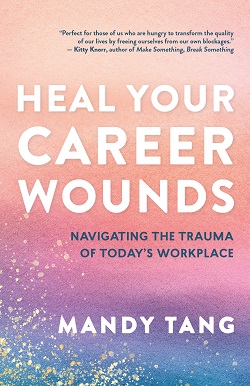
Mandy Tang is the author of Heal Your Career Wounds: Navigating the Trauma of Today’s Workplace. A career coach and wholistic healer, she helps clients from Big Tech, startups and the nonprofit sector bring more creativity and joy into their work lives. Her training includes an MBA in finance from Columbia, certification as a trauma-informed Yoga instructor and completion of a three-year shamanic practitioner program. Mandy runs the popular TikTok account @CareerCoachMandy with over 161K followers and a Skool community of artists and creators called the Everyday Creatives Club that meet weekly for accountability and inspiration. Visit her online at www.mandytang.co.
Excerpted from the book Heal Your Career Wounds: Navigating the Trauma of Today’s Workplace. Copyright © 2026 by Mandy Tang. Reprinted with permission from New World Library.
images: Depositphotos