
Nearly everyone has emotional prisoners locked in their chest or belly. These are emotional replicas of people you’ve resented or felt have betrayed or hurt you in the past. You keep them there, unconsciously guarding them, just like a jailer.
When you’re reminded of an old resentment, that emotional prisoner comes to life and troubles you. You get a stab in the chest, a band of tightness across the chest or an ache in the tummy. You then can’t meditate or be really still because something’s going on in your body that you don’t understand. Your prisoners are screaming, “Free me, free me,” but it’s human nature to hold tight and not let them go.
These unconscious emotions provoke us to accuse and blame other people and events for our life instead of facing the fact that it’s ‘my’ life and ‘I’ alone am responsible for it.
What you have to do is consciously practice releasing your prisoners. And remember, some of them are ‘institutionalized’ and comfortable where they are. They don’t want to go. And if they do go, they’ll soon return, unless you’re vigilant.
Releasing prisoners isn’t the same as forgiving the people concerned. You wouldn’t need to forgive if you hadn’t judged. The need to forgive arises from the judging of others. While you continue to judge others you’ll be moved at times to grandly forgive them, when really, you’re the one causing the emotion with your judging. No matter how much you say you forgive, other prisoners will remain in your chest to trouble you.
This is because human nature has interpreted forgiveness as forgiving a particular person or people. They’re identifiable. And that’s the error. What you have to practice doing is forgiving all your prisoners, the whole lot, NOW, all at once, without naming. You let them go altogether like a flock of birds.
And the reason it works isn’t because you think you’re letting them go, but because you’re consciously, at every moment, giving them no place to rest inside you. There are also many forgotten emotional hurts buried in your body that you just can’t identify. Trying to identify them doesn’t work if you’re serious about returning to the state of simplicity or guilelessness, which is essential to inner freedom.
The practice of this step is to say, and really mean it within, “I release everyone I ever thought or felt hurt me, failed me or harmed me. I will have none of this resentment in me.
“I surrender now and every moment this lack of innocence, this judging of others. I will not have it.”
And to the emotions, “I will have nothing in me against anyone. Be gone from me. I free you in love.”
You have to walk around consciously emptying yourself of resentment towards any person or event. Consciously means not just reciting the words intellectually, but being there with your intelligence.
Resentment undermines your physical and psychological well-being and helps to spoil the quality of life.
Something else to bear in mind is that while you judge others you will judge yourself and cause self-doubt. Self-doubt is a very troublesome and common emotion among people.
The old saying, “forgive your enemies” can be misleading if it’s not done in the wholehearted and immediate way I’ve described. If you tell your child at school when he or she is punched and bullied to forgive the one who bullies them, you’ll confuse the child. The young can’t really forgive; they’ll only suppress the emotions and suppression builds up in the body as unhappiness.
It’s much the same with, “love your enemies.” You can’t love your enemies. But you and your child can be intelligent enough not to hold anything against anyone—while still taking any external practical action you’re moved to.
Please know that this meditation isn’t like any other. It has unfolded in the author during more than three decades of spiritual teaching. The meditation doesn’t involve visualization. It’s original and non-idealistic and covers the whole human condition as something practical you can always do.
At every stage of meditation you have to be practical. You have to see things as they are and not as you or others imagine them. If it’s not practical—something you can do—what’s the good of it?
Who are your emotional prisoners?
So, have you any prisoners in there? Do you think you were betrayed? Do you think you were abused by your mother or father, perhaps sexually abused, and hold on to the thought of it? It’s the thought that keeps the painful emotion alive. Endeavour to never think about it and your quality of life will improve.
It is human nature—not our real nature—to blame others. In the wider scheme of things, all of us are to blame or nobody is to blame. We’re the product of 2,000 million years of life on Earth. Who are you going to blame for all that?
You can’t meditate unless you’re still. Emotional prisoners inside your belly or chest are going to play up.
Because the human mind and emotions repair themselves so quickly, you have to be constantly on guard against being resentful—even of past events. It’s one thing to walk away from an event that causes difficulties in your life or to see it through (whichever you’re moved to do at the time); but it’s something else to do this without allowing resentments to take hold, either at the time or later when you’re tempted to look back. This applies particularly to past lovers and past painful events.
The fact is, you can’t meditate unless you’re still. Emotional prisoners inside your belly or chest are going to play up. When someone mentions a name or event alluding to them, the emotions vibrate at the level of the resentment, and you’re disturbed. You’ll be still at other times, like many people are who don’t practice this meditation. But to be still sometimes is like having someone jab you in the back unexpectedly. It’s best to know what’s untrustworthy and unreliable in your body—and that is your concealed emotions.
The resentments are very, very cunning. They’re also very, very quick, very swift and outspeed the surface mind. What we’re endeavouring to do is to heighten the immediacy of your intelligence so that eventually it outspeeds any emotion. Then old resentments can’t come back and new ones can’t enter.
It’s a gradual process. You have to practice. And you have to be inwardly moved to practice; otherwise you’ll rush through it, gloss over the point, and the practice will be less effective.
Stop accusing or blaming

So this first step is to stop accusing or blaming others for your life. It’s a big step because every time you have an argument, you’re in effect disturbed by someone. That means you’ve taken an emotional position. It’s possible, as you know, to talk to people without taking a position; in which case, you simply exchange facts. But where emotional issues are involved, both parties tend to talk from biased personal impressions more than facts, and the communication becomes muddied and often heated.
It’s best, as much as possible, for you not to get into accusations or blaming and to keep to facts. The emotions in the other person may not allow this, in which case it’s advisable to conclude civilly and try again another time. Positions create counter-positions.
Spiritual freedom comes down to no longer being a slave to your emotional self.
The human race has been blaming each other and events for its unhappiness and ignorance since time began; and all this has done is cause more unhappiness, self-doubt and a lack of love. You have to see this for yourself. I can only point the way.
So, are you holding anything against anyone? Or holding on to any painful events? Don’t answer off the cuff.
Pause.
Wait.
Look within.
Be still.
If something is there let it reveal itself—which it will.
And release it.
Finally, when your prisoners are freed, so will you be to that extent, and there’ll be nothing there—except the reality in Step Two.
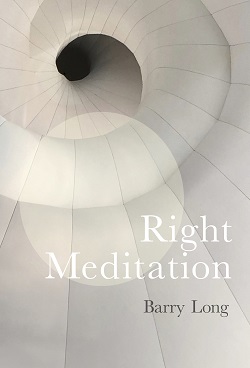
Barry Long’s first book on meditation was published in 1982, just a couple of years before he taught a young Eckhart Tolle and many others at meetings he held in London. Now, Right Meditation: Five Steps to Reality brings together the spiritual wisdom of a lifetime of teaching meditation in a short volume of simple, practical guidance.
The above extract is from ‘Right Meditation’ by spiritual teacher, Barry Long. Copyright The Barry Long Trust 2024.
images: Depositphotos