

Owl replacement

Sherrill came at a few minutes after two. Accompanying her were John Traverso, the tree climber; John’s wife, Alise; four other Lindsay volunteers; and two baby owls!
Another baby needed a home, and the mother wouldn’t mind a second baby, Sherrill said, especially since one of hers had died. When she opened the carrying box, I saw “my” bird, looking truly diminutive next to a “Baby Huey”-sized owl only a week or so older, but nearly twice the size!
Sherrill also brought a large straw basket. The current nest, she explained, was a platform-like thing that some hawks had left in the tree a few years back. (I was surprised to learn that owls don’t build nests, but take over the abandoned ones of other birds.) The hawks’ nest, however, hadn’t been safe for the babies. It would be replaced by this basket with high sides, from which there would be no tumbling out!
[su_pullquote align=”right”]We all had a little scare: the line appeared to be giving way, and John started to fall![/su_pullquote]
John Traverso soon set to work, throwing a line over a high branch in the tree, putting on a harness and then quickly pulling himself up 60 feet (about 18 metres). At one point, we all had a little scare: the line appeared to be giving way, and John started to fall!
However, this seeming danger only lasted a second. What happened, John explained, was that he’d looped his line over a small branch that was just above the big, sturdy one he’d been aiming for. The small branch gave way under his weight, but after falling an inch or two, the line was secure around the big branch.
As John climbed, we witnessed the sight of the mother great horned owl fleeing from “this meddler” in her tree! I had a quick glimpse of her great wings pumping, before she disappeared into the branches of another tree a couple hundred feet away.
From there, she began to hoot at us and to make angry-sounding cracking noises that I’d never associated with owls. After a time, she stopped sounding off and flew off to another location, no doubt still nearby, where we couldn’t see or hear her.
John got established within reach of the owl’s nest. He called down to us that there seemed to be three babies still in the nest! Sherrill said, “That would make five altogether! I’ve heard of four owl babies before, but never five!”
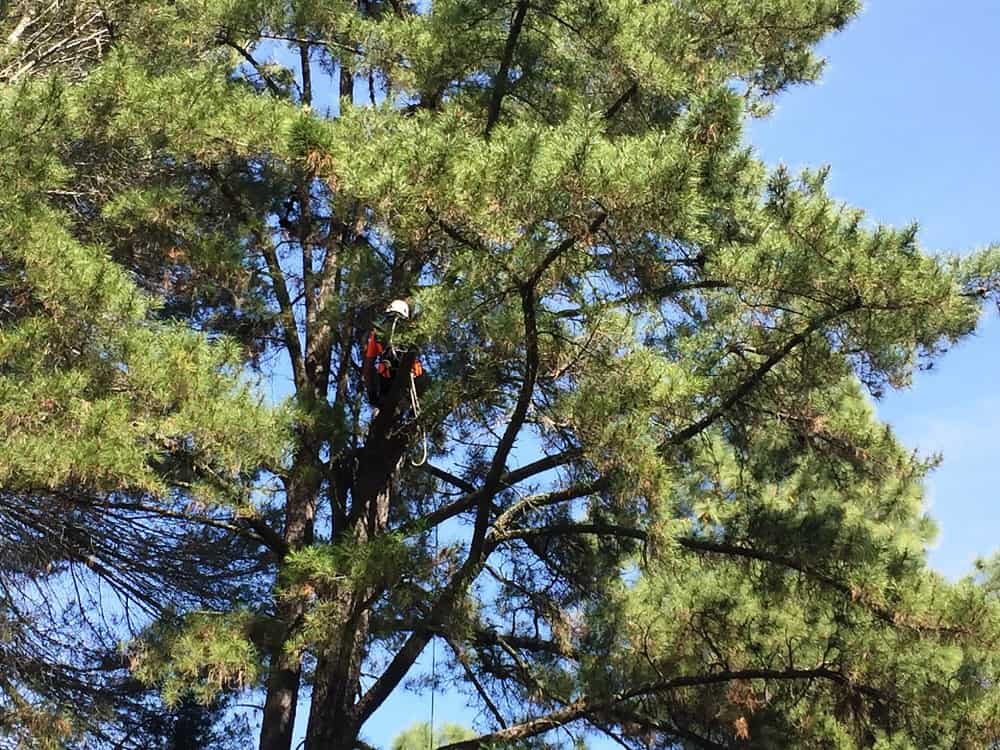
In a moment, getting even closer, John corrected his first assessment. “There’s one baby up here,” he said. “The other two things are dead gophers, cued up as food.” The gophers, he told us later, were headless.
When John was properly positioned, Sherrill set to work putting leaves and pine needles in the bottom of the basket, and then adding six dead mice, enough food for the mother to feed the three babies that night. Using the rope as a pulley, she ran it up the tree to John.

As soon as he’d secured the basket and placed the contents of the old nest inside it, she began covering the two owls in the box with a small blanket, to protect them in case of jostling on the way up. Then she closed the box and soon it, too, was being hoisted.

Before long, John was back down on Earth. The mission appeared to have been 100 percent successful. And whatever some imaginary Modern Bird’s Nest magazine might say about “these tacky basket nests”—who cares, the birds are safe!

Takeaway thoughts

Several days have passed. Though the basket in the tree isn’t easy to spot at first, once you see it—well, the phrase “sticks out like a sore thumb” comes to mind. The birds, however, aren’t at all visible. Sherrill told me that in four to six weeks, the babies will begin practicing walking on the branches near the nest, and the Mom will likely put in appearances, too, as she encourages and supervises them.
I feel happy to have these neighbours, one of whom was once our overnight guest. I’ll always feel the bond!
Our neighbourhood is part of the vast area of intersection between the habitats of people and “wild” animals. We humans tend to go about nearly oblivious to the presence of our often invisible neighbours.
However, when a coyote walks down the path that Barbara’s office window looks out upon—as happens every morning—or when the owls hoot (I learned that owls hoot during the mating season, stop after the babies are born, and start up again as the babies are learning to fly), or a more distant pack of coyotes all howl together at night, it’s a thrill! And to intimately care for one of these neighbours and help it survive is an experience that feels as if it enters the realm of the sacred.
«RELATED READ» WILDLIFE ISN’T A PROBLEM: Let’s stop calling it that»
image 1: John Traverso; image 2: Wikimedia Commons; all other images: Max Reif