


To say that the personal self is an illusion isn’t to say that you’re not a unique soul on a unique journey. It’s only to say that the human character you appear to be isn’t your real or enduring identity. Your body is nothing more than a carrying device in which your soul is housed, giving the soul a chance to immerse itself in the human experience.
Think of the body as a costume your soul puts on to dive into the human drama with. The personal self constitutes all the programs of the ego, a collection of conditioned responses and egoic patterns that can, with insight and discipline, be deconstructed and transcended.
Transcending your personal identity doesn’t erase your participation in the human drama, nor does it eradicate your sense of self. In fact, your sense of self becomes much stronger without the limitations of personal identity and self-concepts. Friends and loved ones will still call you by your first name, and you’ll still respond. The flow of life will go on just as it always has.
The difference is that you’re no longer inwardly identified with your body. Inwardly, your identity has shifted from the transient physical form to the eternal spirit dwelling in it.
The hypothetical self

Follow me now on this particular line of reasoning. Where exactly is this personal self you believe you are? Where is the ego? You may point to your physical body and say, “Here it is!” And yet, if someone strikes you unconscious, your body can’t act or speak by itself. In order for your mind and body to function, they require a consciousness to inhabit them. Where is that consciousness located that you believe to be a personal self?
Is there truly an isolated entity nestled behind your eyes, orchestrating your thoughts, emotions and actions? Is there actually a separate individual who thinks, feels and acts apart from the rest of the universe? If such a personal self did exist, could its condition of separation from the whole be proven? In spiritual philosophy as well as psychology, we call this idea of a personal self the ego, but it might be more aptly named the hypothetical self.
The ego, or personal identity, is entirely hypothetical in every sense of the word. It’s constantly being implied and affirmed, but it is never demonstrated to exist in reality.
Consider whether anyone else can see your personal identity. A personal identity is just an idea. To elaborate on this point, let us suppose there is a man named John Henry Doe, born and raised in central Michigan, a former all-American high school athlete who now works at a law firm on the south side of Detroit. John Doe is divorced and remarried and has four children. This is the basic “identity” of John Henry Doe: how he sees himself, thinks about himself and presents himself to others.
If someone were to ask this John Doe, “Who are you?,” he would likely begin rattling off all the aforementioned details. “My name is John Henry Doe, I was born in central Michigan,” and so on. None of these details are who John is; they’re all simply things he has done, and therefore they can’t possibly be his identity.
For example, would a complete stranger who looked at a photograph of John Henry Doe see any of these personal identities? Would they see these identities if they bumped into him on a busy street? Obviously, they would see only what his physical appearance showed them in that moment.
All of John Doe’s self-definitions, including his name, would be invisible to the stranger. None of John Doe’s personal identities would be visible or apparent to anyone but himself, making them clearly illusory and unreal.
The ego is only an idea
The ego exists without any real support, being only an idea in the mind and therefore relying on the agreement of others.
This sad fact keeps the human ego in a perpetual, relentless endeavour to project and validate its concocted identities onto others, craving and seeking validation through tales of triumphs and tragedies, wanting always acknowledgment or sympathy in a desperate bid to solidify its ephemeral existence. Simply put, the ego is on an endless quest for self-assurance, for external evidence of its own reality, of which there is none.
Dear reader, does truth have to fight hard to prove itself, or is truth self-evident? Truth doesn’t thrash about, desperately clamouring for acknowledgment. Truth sits quietly, serenely self-assured. This is precisely how we can discern that the ego isn’t based in truth, because the ego does just the opposite.
The ego’s need to maintain its personal identities places an immense burden on our consciousness. It’s a ceaseless task to prove, defend and bolster these identities in the minds of others, and therefore in our own mind. It’s an absurd merry-go-round where each and every day, irrespective of yesterday, we’re tasked with repeating the same performance all over again.
The notion of transplanting a mental identity into the consciousness of another person is as futile as attempting to hand over a thought directly from your mind to theirs. Despite all our best attempts to convince others of our own identities, others will always perceive us according to their own state of consciousness.
The ego fails to see that identities are like mirages—they dissipate upon approach. The ego is forever chasing its own tail in this regard, desperately seeking to find validation for imagined identities that remain always just out of reach.
Imagine yourself as a kaleidoscope
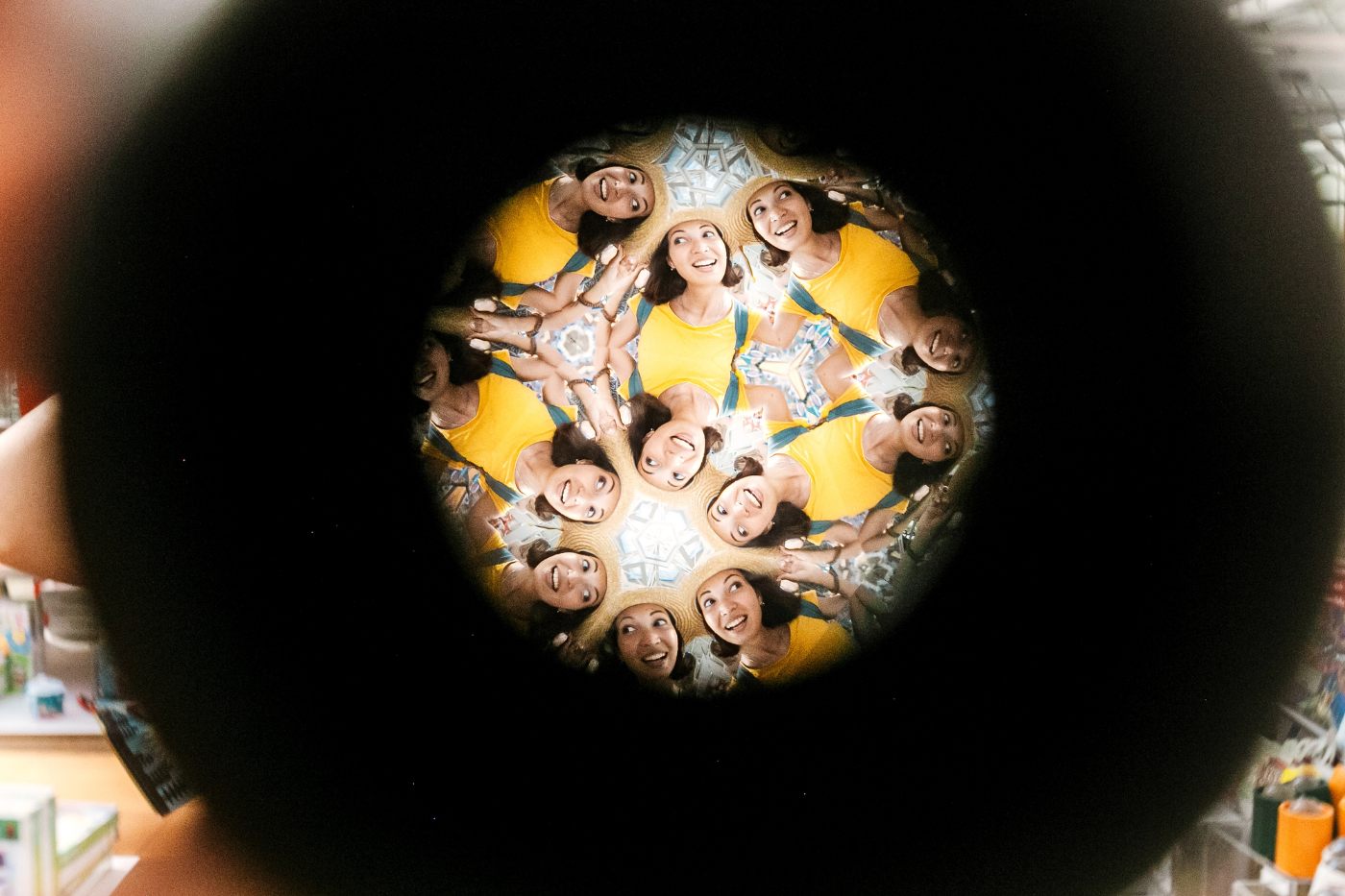
Imagine a kaleidoscope of different aspects of yourself, each viewed through a different lens by every person you meet. No matter how much you attempt to project your chosen identity, each new onlooker crafts their own mental version of you, coloured by the hues of their own personal experiences, personal conditioning, likes and dislikes.
You become, in effect, a gallery of projections, none of which captures the true essence of what you are. A slightly different version of you exists in the mind of every person you know. Which version is the true one?
The ancient Greek philosopher Heraclitus once said, “No man ever steps in the same river twice, for it is not the same river, and he is not the same man.”
The idea that one could ever present a singular, unambiguous identity to the world is as whimsical as believing in the possibility of stepping into the same river twice. Just as the waters are ever-flowing and ever-changing, so too is the perception of you in the minds of others a fluid mosaic, reflecting not who you are but who the perceiver is.
Thus, we’re reminded that each of us is but a drop in an infinite ocean, and our attempts to define and assert our identities are merely whispers against the cosmic roar of the universe. We are, each and every one of us, a universe unto ourselves, a unique and onetime cosmic event that has never occurred before and will never occur again.
The idea that we’re distinct, separate entities from the universe that envelops us is, when you stop to ponder it, quite an extraordinary supposition. We’ve always assumed that we don’t already abide in perfect unity with everything. If the essence of who we believe ourselves to be hinges on this untested assumption of separateness, it stands to reason that we should be profoundly curious, even eager, to scrutinize and explore this belief.
How universes come to be
The universe of the personal self is formed within the mind in much the same way as the cosmos itself. Each new universe begins with an explosive, incandescent bloom of light, matter and energy, all unfurling from a singular point of infinite density.
This Big Bang marks the birth of every new universe, scattering galaxies like dandelion seeds across the fabric of space-time. The light, gas and dust from this unfathomable explosion eventually form galaxies, stars and planets. Each universe exists for untold billions of years until the return movement begins, and eventually the whole process completes and repeats itself.
Like a balloon stretched to its limits, the cosmos must eventually recoil, collapsing back into that primordial singularity from which it began, only to be reborn anew in the perpetual dance of creation and dissolution. A new Big Bang instantly occurs, creating the next universe, where this same pattern repeats, like the great heartbeat of God.
Our universe is built from fractal patterns that repeat themselves at every level of Creation, from the macrocosm down to the microcosm. Pinecones, seashells and flowers spiral in the same Fibonacci pattern as do the spiral galaxies.
“Let there be light” is an eternal law that declares there is never a moment of absolute or total darkness, for the instant one universe dissolves into the void, the next one is already expanding into light.
Our universe is built from fractal patterns that repeat themselves at every level of Creation, from the macrocosm down to the microcosm. Pinecones, seashells and flowers spiral in the same Fibonacci pattern as do the spiral galaxies. The pattern of tree branches mirrors the branching of the blood vessels in our lungs. The same divine patterns and principles repeat through all Creation.
In this way, the ego is like a “Big Bang” in the mind, where a miniature universe of personal identities is born. From the moment of birth, the ego begins its outward expansion, amassing experiences, identities and perceptions much as the universe gathers galaxies, stars and planets in its ever-widening field.
This egoic universe continually expands and complexifies, each new thought like a new star born in the expanse of consciousness, each new identity a galaxy taking shape in the vastness of being. Yet for many, this egoic expansion is the totality of their existence, as they never reach the dissolution process that would be akin to enlightenment.
For the majority, the cosmic journey of a human lifetime ends not with enlightenment, but with the need for another turn around the wheel of samsara, another cycle of birth and death for a chance to pierce the veil of forgetting and remember the unity that underlies all things.
Humanity’s fundamental problem

The egoic identity is so strong and enticing that souls require countless trips on the merry go-round of human incarnation before they finally transcend it. It’s so strong that even though it’s the cause of all our suffering, we still cling to it resolutely.
Herein lies the fundamental problem with humanity’s approach to life. It seeks to attain something better without first becoming something better. It wants to acquire something greater without looking inside itself for it. It strives to blot out sin with the accumulation of knowledge rather than the humility of forgiveness. It wishes to rid itself of ego without truly facing it, and to remove its pain without truly feeling it.
But who can really change someone other than themself? What outside force can solve an inside problem? No external remedy can heal an inner affliction. All the world’s riches offer no solace to the torments of the human soul. The inward journey back to unity consciousness is the most profound adventure of all, and it’s the only fulfilling journey a soul can make.
Aaron Abke is the author of The Three Beliefs of Ego. A spiritual teacher and thought leader who delivers a fresh new perspective on self-realization, his online academy for consciousness expansion, 4D University, has more than 10,000 members. Multiple Gaia TV series, chart-topping spirituality podcasts and SiriusXM radio programs have showcased Abke’s passion and purpose, which is to awaken this planet to the awareness of our oneness. He lives in Austin, Texas. Visit him online at www.aaronabke.com.
Adapted from The Three Beliefs of Ego: A Sufferer’s Guide to Freedom. Copyright © 2025 by Aaron Abke. Reprinted with permission from New World Library. www.newworldlibrary.com

images: Depositphotos

