


Smoke curls over a border town, rising from streets torn by rubble and echoed by distant gunfire. Families clutch what they can carry, fleeing homes that may never exist again. In a control room thousands of miles away, strategists debate how best to “ensure protection” and “neutralize threats” by drawing lines on maps, signing orders to supply weapons, and legitimizing groups who’ve been labelled allies in the fight against terrorism.
The rhetoric is precise, clinical: prevention, defense, security. The human cost is abstract, involving displaced children, destroyed schools and shattered lives, but the moral calculus seems unquestionable. And yet, despite this cold calculus, Gandhi’s radical warning pierces through: The ends do not justify the means.
When most people think of Mahatma Gandhi, they picture marches, spinning wheels and India’s triumph over colonial rule. But the radical core of Gandhi’s life wasn’t in the grandeur of protest or the spectacle of leadership. It was in a principle so simple, and yet so profoundly subversive, that it unsettles the world today: justice pursued through cruelty, expediency or compromise is no justice at all.
The temptation to justify any means
Part of what makes the temptation to justify any means so powerful is a sense of moral certainty. When people are convinced that their cause is righteous, they feel entitled to achieve it at almost any cost. Anything short of success is perceived as a moral failure, a forfeiture of the good they’re pursuing.
This logic fuels cycles of violence and compromise: arming allies, sponsoring interventions or legitimizing violent actors all feel acceptable, if the “end” is protection or prevention.
We see this playing out in the United States today with sweeping immigration raids. Some claim with absolute certainty that undocumented migration is immoral, thereby framing every person who has entered the country without papers as a criminal. From there, it’s a small step to insist that anything that’s necessary—regardless of constitutionality, human rights or ethical principle—must be done to remove them.
Progress doesn’t always require destruction
Some argue that progress inevitably requires destruction—that to make an omelette, you must crack a few eggs. History and nature are often cited as evidence: entire forests are burned to allow ecosystems to regenerate, and new stars and even solar systems are born from the death of older stars. By this logic, the means are irrelevant if the outcome is creative or transformative.
However, Gandhi’s radical insight challenges this reasoning. Unlike natural cycles, human societies are conscious and capable of choice; the suffering we inflict isn’t inevitable but avoidable. Violence, no matter how justified it seems when you consider its promised outcomes, corrodes the moral fabric of those who wield it and the communities that endure it.
True progress, Gandhi would insist, can’t be measured only by what is created. It must also be measured by how it’s created, by whether the means themselves honour ethical principles and human dignity.
Gandhi’s radical insight
Gandhi’s radical insight disrupts the reasoning that moral certainty and violent expediency justify action. He has recognized that conviction alone doesn’t license cruelty; the righteousness of a cause is inseparable from the integrity of the actions used to advance it. True courage, he has insisted, is having the discipline to pursue justice without betraying ethical principles, even when certainty tempts you to take a shortcut past them.
Gandhi’s warning about untouchability captures this radical ethic. “This canker of untouchability has travelled far beyond its prescribed limits and has sapped the very foundations of the whole nation” (T-3-182).
Oppression, as he understood it, corrodes not only those it directly targets but the moral integrity of society itself. The temptation to fight brutality with brutality, even under the banner of liberation or protection, is a trap that repeats itself across generations and continents.
The significance of Satya
Central to Gandhi’s philosophy was the idea of Satya, or truth. “Though God may be Love, God is Truth above all” (T-3-144). For Gandhi, truth wasn’t an abstract ideal; it demanded absolute ethical consistency.
He extended this vision of justice beyond India, linking the struggle for independence to a broader moral mission: to free “so-called weaker races of the earth from the crushing heels of Western exploitation” (T-2-327). Justice, in Gandhi’s view, could never be selective or convenient; it was universal, and it required integrity in both intention and action.
This principle is strikingly relevant when we examine international conflicts. Arming Israel under the banner of protection, sponsoring interventions to prevent genocide that inflame violence, or legitimizing violent actors to combat terrorism—these policies illustrate the moral peril Gandhi warned against.
Expedient “solutions” that rely on unethical methods may produce short-term results, but they perpetuate cycles of harm that echo across borders and generations. Responding to cruelty with cruelty never ends the circle; it only ensures its repetition.
Gandhi understood that time itself is a moral medium. “Time is wealth, and the Gita says the Great Annihilator annihilates those who waste time” (T-2-274). To chase expedient outcomes while compromising one’s principles isn’t merely ineffective; it’s a moral waste. Every moment spent rationalizing violence as necessary, as well as every act that betrays ethical coherence, only deepens cycles of oppression and leaves society weaker instead of stronger.
A Wheel of Nonviolence
Gandhi’s insistence on nonviolence wasn’t pacifism but a disciplined moral strategy. “To answer brutality with brutality can only start a vicious circle” (MM-146).
Nonviolence, in keeping with Gandhi’s formulation, is the foundation of sustainable social change. It’s the engine of what can be imagined as a Wheel of Nonviolence, where courage, ethical discipline and commitment to truth revolve together to create lasting transformation. Violence may produce temporary victories, but only nonviolence produces justice that endures.
In our contemporary world, where geopolitical power is often exercised with moral compromise, Gandhi’s ethic appears to be a radical challenge. Arming, legitimizing or sponsoring violence in the name of protection or prevention may appear strategic, but it risks perpetuating the very crises it seeks to solve.
Ultimately, true liberation can’t be built on methods that betray its own ethical foundation. Gandhi’s five principles—truth, nonviolence, self-discipline, fearlessness and service—demand coherence among intention, action and outcome. They ask us to confront not only the brutality of others but the compromises we’re willing to make ourselves.
What can we learn from Gandhi?
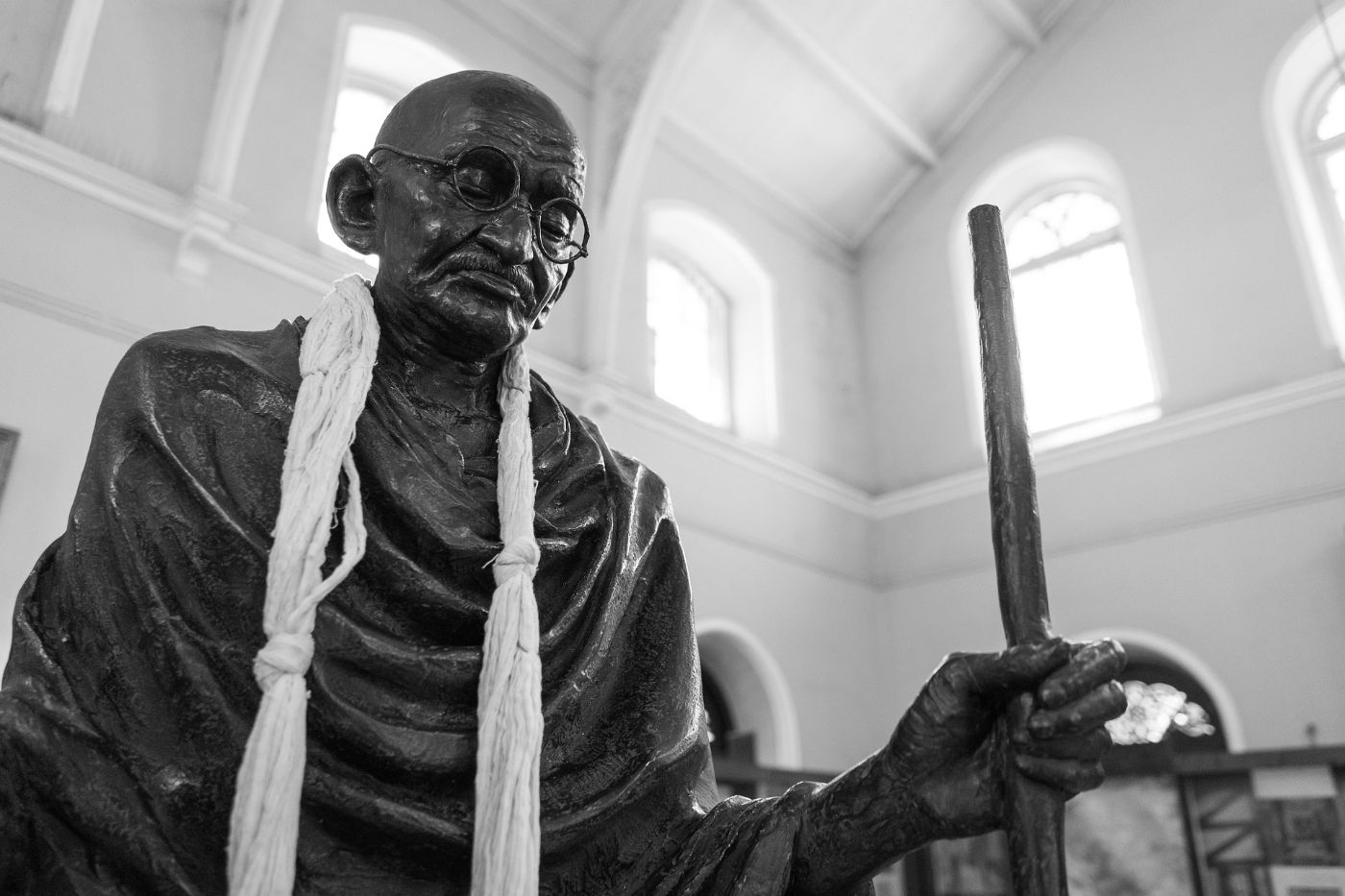
The radicalism of Gandhi’s life lies in its quiet insistence that power and morality are inseparable, and this is a lesson we ignore at our peril. In a world that’s eager to rationalize cruelty for the promise of good, his ethic challenges us to imagine a different approach: to act in truth, to resist the seductive logic of expedience, and to measure success not only by outcomes but by the integrity of the means used to achieve them. Liberation that betrays its own ethics is no liberation at all.
The examination of Gandhi’s life offers a question as urgent today as it was in his time: Can we pursue justice without betraying our own humanity? When it comes to confronting cycles of violence, oppression and moral compromise, whether they relate to war zones abroad or immigration raids at home, this is the radical challenge he’s left for us.
Courage isn’t measured by spectacle, but by the quiet, unflinching commitment to moral coherence in a world that constantly tempts us to settle for less. To live by Gandhi’s principle that the ends don’t justify the means is to stake a claim on a world that is at once just, ethical and enduring, a world that has yet to be fully realized.
Editor’s note: The citations in this piece come from Gandhi’s writings and can be accessed via this free ebook.
image: dcprotog

