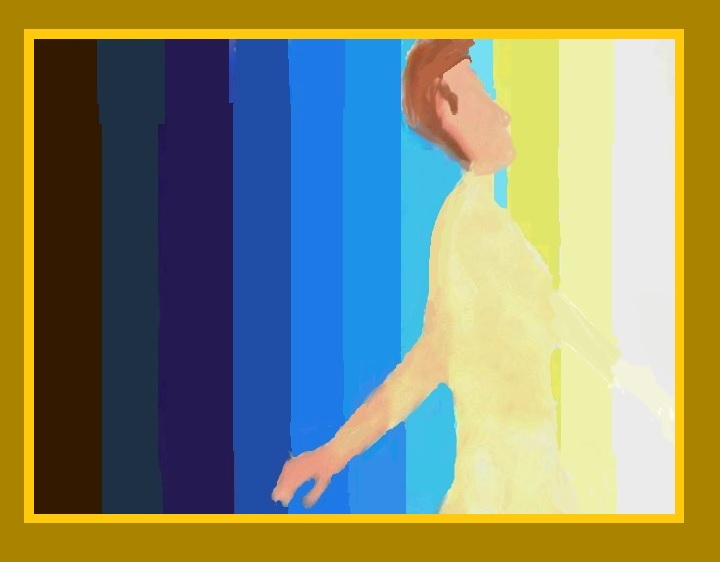


If you look closely, there is a kind of seeing that happens before the eyes open.
Before recognition, before the mind decides what a thing is, the first note of awareness plays. The world reveals itself in its raw language of texture and timbre.
We rarely stay there long. The mind rushes to translate, to categorize, to name. But
attention—true attention—asks for something different.
It isn’t a command.
It’s a listening.
When I first began meditating, I treated attention like a leash for thought. I tried to rein in the chaos, to make stillness obedient. It took me years to understand that awareness doesn’t need to be forced. It knows how to settle itself.
In their paper “The Attention System of the Human Brain,” Michael Posner and Steven Peterson describe attention as a dynamic system of neural networks that select and stabilize experience. But long before neuroscience named it, Buddhist phenomenology recognized the same intelligence: sati as awareness, samādhi as collectedness, and paññā as insight born of clear seeing. Together they form what neuroscientist Francisco Varela, in 1996, called “a first-person method of investigation”—a way of studying consciousness from within.
Attunement before the eyes open
I’ve come to think of this as a quiet intelligence. Not intellect, but attunement. The body already knows how to orient towards coherence—like when it leans towards sunlight or turns instinctively towards a sound that matters.
When awareness opens this way, perception feels less like work and more like music. You start to hear how everything hums at its own frequency: the percussion of breath, the soft chorus of wind, the high note of thought rising and then fading.
To listen without grasping is to let the symphony play itself.
There’s no need to understand every sound. The mind wants analysis, but the heart understands rhythm. As Jon Kabat-Zinn once wrote, “Mindfulness is the awareness that arises from paying attention, on purpose, in the present moment, non-judgmentally”. But there’s another layer beyond non-judgment—it’s the layer of intimacy. An awareness so attuned that it no longer observes from a distance: Instead, it participates.
Mindfulness is more than a technique
That’s where mindfulness becomes something larger than technique—it becomes artistry. Not because it’s decorative, but because it’s honest. It teaches us to stop rearranging experiences and to witness how coherence arises on its own.
Sometimes this coherence appears as ease, other times as ache. Either way, attention holds it in the same way a canvas holds colour—without judgment, without resistance.
The intelligence of attention isn’t in what it knows, but in what it allows.
It allows complexity without needing conclusion.
It allows beauty without needing possession.
It allows the moment to complete itself, then pass.
And when it passes, something subtle remains—not peace exactly, but alignment.
A sense that awareness and the world are finally moving in rhythm again.
«RELATED READ» THE ART OF ATTENTION: Reflections on the work of John Muir Laws»
image: Pezibear