
Around 10 years ago, I spent a weekend reliving my teenage times by renting a couple of ’90s World Wrestling Federation (WWF) pay-per-views. I didn’t make my then-girlfriend watch them with me, but she received indirect exposure—for the first time. Apparently it’s a lot to take in: the strutting egos, the acrobatic violence, the melodrama, the bombast. She advised that while most of my hobbies and interests were respectable, this one really was “the dumbest thing ever.”
It’s OK if you share that view: This piece probably won’t change your mind, and that isn’t my intention anyway. But I do think it’s worth considering how the alleged Dumbest Thing Ever can provide a useful tool for reflection on the bombast and melodrama of everyday life.
The vocabulary of illusion
When I got into pro wrestling as a young teenager, I could hardly walk past a magazine on the topic without opening my very thin Velcro wallet. Many of these mags, especially Pro Wrestling Illustrated, were known for preserving something called “kayfabe.”
Kayfabe is the industry code of silence that, classically, insists that wrestling is real. To maintain kayfabe is to negate that wrestling’s outcomes are predetermined. It’s to deny that the alliances, antics, feuds, feats of Herculean heroism and infamous misdeeds are the creative work of writers and trained professionals who are committed to crafting entertaining television and live events.
It’s to act as if the world champion really is the most skilled or insuperable combatant, rather than the one who’s been trusted to carry the leading role in a televised physical drama.
Magazines like Pro Wrestling Illustrated reported match outcomes as if they were competitive events and storylines in reality. The non-competitive nature of wrestling had been common knowledge among the public for many years, but the industry itself—including the magazines that were devoted to it—held the line, remaining committed to nurturing the audience’s suspension of disbelief.
The term “mark” stems from pro wrestling’s carnival sideshow origins, in which a mark is a kind of sucker, someone who’s able to be duped.
Yet, as the internet became more accessible and wrestling gossip flourished online, maintaining the charade seemed more futile than ever. PWI marched on, while others began catering to the fans’ increasing insider knowledge. I picked up a magazine around 1998 that actually included a glossary of wrestling terms laying out the whole thing. It included “kayfabe,” of course, which is really the linchpin (speaking, as it does, to a “backstage” reality).
But there were more: “gimmick,” for instance, refers to a wrestler’s stage persona. Maybe he’s a tyrannical corrections officer (Big Boss Man) or a colossus hiding horrific burns under a leather mask (Kane). Wrestling is intensely melodramatic, so of course there are names for standard role types: there’s “face,” short for “babyface”—a good guy; bad guys are “heels.”
When a babyface does bad guy stuff, he might be engaged in a “heel turn”—his character is being transformed from a goodie to a baddie. At this point, he hopes to draw “heat”: a clamourous response from the crowd that affirms its engagement in the drama.
And there was “mark.” A mark is someone who buys into the illusion. This contrasts with someone who’s “smart”—smart to the business, to wrestling’s true nature. The term mark stems from pro wrestling’s carnival sideshow origins, in which a mark is a kind of sucker, someone who’s able to be duped.
While wrestling performers, promoters and distributors naturally want people to engage enthusiastically with their product, to have their emotions aroused or even inflamed by it (just as they might find themselves worked up by a great movie), the term “mark” has always retained a sense of the pejorative. Not merely an appreciator, a mark is someone who’s gullible.
These days, kayfabe is maintained more loosely than ever: candid interviews and press events abound. Surely, few people above the age of 10 are pure marks, in the sense that they still believe in the reality of wrestling?
Marks of all shapes and sizes
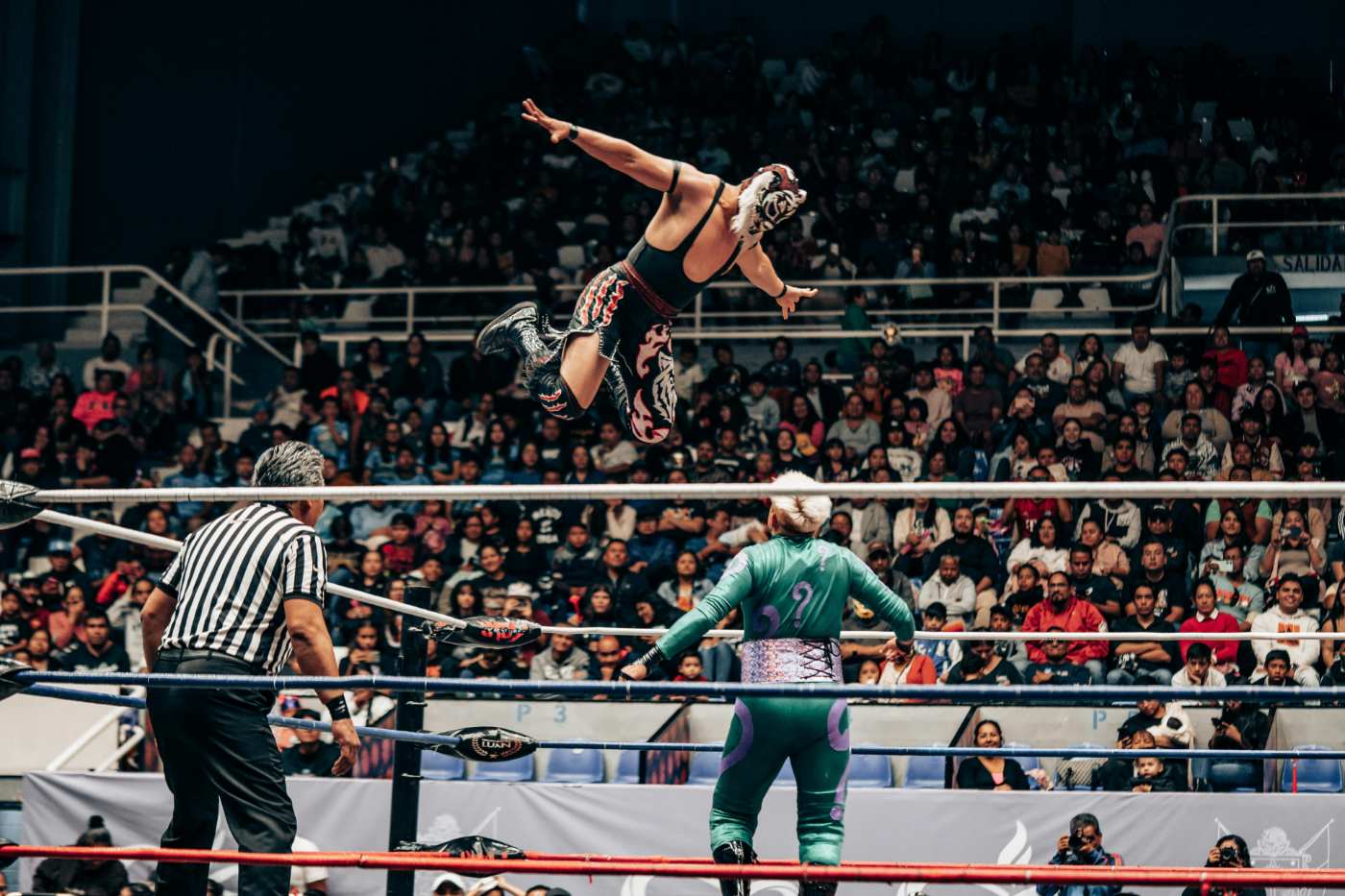
There has long been an intriguing flexibility to the term “mark” that allows for the spectrum of ways people can be seduced by an illusion, and their fascinating tendency to fall into this trap despite really knowing better.
A little while ago, a wrestling publication invited fans (through social media) to identify good wrestlers with mediocre finishing moves. Someone nominated the “Cross Rhodes” rolling cutter, the signature move of beloved babyface Cody Rhodes. Some agreed, while others disagreed. Inevitably, though, some devotees were piqued to defensiveness: If it was indeed such a weak finisher, why had it capped off so many premier opponents?
This is a “mark” response. It finished them off because the matches are scripted that way. Cody’s antagonists aren’t really knocked irrecoverably flat. And people who make such comments really know better; they just get carried away. In an era in which websites and fans alike analyze pro wrestling as a creative product, such responses aren’t plausibly dismissed as simple ignorance. I think it’s instead indicative of the ease with which we tend towards reactivity, of how easy it is to be lured into infatuation or offence.
Mark responses emerge in numerous and seemingly unlikely forms. Social media is filled with interviews with wrestlers who are speaking out of character, out of kayfabe (these are termed “shoot” interviews). If they seem a bit too sucked into their own fame and fiction, they’re labelled “a mark for themselves” by commenters: acting as if they triumphed in a sporting meritocracy rather than through the assent of writers, bookers and obliging “opponents.”
According to PWTorch.com, a mark may also be a wrestler “preoccupied with fan-perception (such as holding a title belt) more than being concerned with being paid what he is worth.” Controversial ex-booker Vince Russo, whose disdain for fans who take wrestling too seriously is such that he calls one of his regular podcasts “Castrating the Marks,” has spoken about the danger of wrestling creatives themselves being marks for the talent. Buy into a wrestler’s mystique and they’ll badger you for matches, storylines and attention that boost their personal profile to the detriment of overall content quality.
“Mark” seems to capture the idea that balance and perspective aren’t stable qualities. Fans can know what they know about wrestling but still find themselves “marking out” now and again.
All the world’s a stage—or an arena
You might sense by now what this has to do with mindfulness. Mindfulness practices are a tool for combatting being “caught up,” for mistaking temporary impulses, thoughts or feelings for reality.
Every day, we experience emotional responses that we act upon without reflection. We often take them as a cue for what must happen, for how things really are or how things should be.
When we’re beset by anxiety, for example, the experience often seems totalizing and the tonal quality of reality itself is transformed. It’s hard to conceive that later, we may feel differently. Mindfulness meditation offers us the opportunity to practice “perspectivizing,” a kind of objectifying of our emotional responses.
Mindfulness meditation offers us the opportunity to practice “perspectivizing,” a kind of objectifying of our emotional responses.
The emotions don’t typically disappear immediately, but we might be lifted gently above the current of believing everything we think or feel. And, in doing so, we escape the reactiveness of being a mark—a mark for the hollering melodrama within.
This isn’t a “natural” process: it’s being a mark that comes most naturally. As Robert Wright points out in his book Why Buddhism is True: The Science and Philosophy of Meditation and Enlightenment, in which he writes about the evolved purpose of emotions, feelings seem to “feel right and true almost by definition. They actively discourage you from viewing them objectively.”
In meditation, however, we can first allow our nervous system to settle, and then recognize emotions as they present themselves. We can observe them without being them, without allowing them to direct the next thought or the next action. As we learn to reappraise these as the “experiences” they are, we might find breathing space beyond or around them that becomes space for assessing a response to a problem (if one is indeed required): a smart response, rather than a mark one.
The perspective-taking fostered by meditation can also reveal the artificial frameworks we might be allowing to direct our thoughts and emotions. How many of those scenarios in which we find ourselves so fundamentally worked up seem, upon mindful reflection, to have little more gravity than the ephemeral theatre of pro wrestling?
Wrestling is a realm of reactivity, of the ego writ large. It’s a realm in which fiercely defined personae strut, strive and retaliate. They clamber for dominance and grasp at recognition, with bold costumes and bold claims, all within a cartoon world that is both easily understandable and, from another perspective, absurd.
You probably haven’t clobbered anyone with a folding chair lately, but could you honestly say you’re never sucked into scenarios that aren’t, in their own way, fictional? Scenarios that, for all their self-important momentum, seemed on sober reflection strangely arbitrary (or even The Dumbest Thing Ever)?
Workplace costumes, roles and rumbles

Most jobs contain elements of pro wrestling: scenarios, routines or agendas that don’t have the weight or consequences we attribute to them in the moment. Large organizations, especially, always have their own kayfabe: things no one seriously believes but all nevertheless affirm.
I’m sure you can think of beliefs in your job, or jobs you’ve had in the past, that are significant only because people believe them to be significant. There might be techniques you know to be ineffective, but which are favoured by management, or apocryphal metrics that are treated as gospel. In workplaces all over the world, people are elevated to higher roles without evidence of excellence, or with evidence of the opposite.
Jobs aren’t moral quests: it’s not usually wise to run around decrying their every fiction. It’s healthy to know how to live with a certain amount of nonsense. But it’s not wise to choose the opposite path, either, and emotionally over-invest—to start believing that pro wrestling is real.
I once asked a very senior colleague how they were doing, to which they responded with serene emphasis: So good. I said I was happy to hear it—was it down to anything in particular? They responded, “I’m working towards retirement now, and it’s really nice to be in the position of feeling that I don’t need to prove myself to anyone.” This was someone with a career marked by considerable security, organizational status and remuneration.
I continued the conversation routinely, but couldn’t help but feel how unfortunate it was to wait until you’re nearly retired to decide you don’t need to prove yourself to others. In such a response, well-being seemed completely bound up in status validation within a particular workplace, as if pro wrestling were very real indeed.
Yet, how many of us engage in similar thinking in our own way, our attention ensnared by mere storylines? It’s easy to find our thoughts and moods not only being centred on daily melodrama, but also mentally amplifying it and offering it heat. At the same time, being a mark might have very real-world consequences at home, as we withhold ourselves from loved ones because we’re still mentally trapped in some noisy pantomime.
Building flexibility and diagnosing drama
So what can you do? Obviously, I think it’s OK to enjoy pro wrestling and similarly, to sometimes enjoy life’s drama. You can hardly spend your life being cynically attentive to the potential falsity of each encounter.
Again, the vocabulary of pro wrestling provides a suggestion: the “smart mark,” or “smark.” A smark is one who enjoys wrestling, despite knowing its true nature: They’re wise to the act but enjoy the performance anyway. They allow for emotional responses, but with a sense of self-awareness. They’re not fans who get blindly caught up.
And again, it’s through meditation practice that this flexibility can be fostered. In meditation, we may realize how busy our consciousness is with old storylines, stale ruminations or futile speculation.
A popular technique for withdrawing from these involves labelling. When you find yourself being carried away by an unhelpful thought, you can recognize what’s happening and blandly label it (for instance, as “ruminating”) before letting it go. Ideally, this metacognitive tendency begins to cross into our day-to-day lives. The ability to recognize and evaluate thoughts and emotions allows us to more effectively focus on what’s useful—to respond instead of simply reacting.
In your day-to-day life, you might find it helpful to consider the Dumbest Thing Ever as a similar label—a tool for recognizing and shaking off the trance that daily dramas induce. The next time you feel caught up in agitation, pause to ask yourself: What’s really at stake?
Some situations will be serious ones with real consequences, sure. But some will really be like pro wrestling: don’t be a mark!
«RELATED READ» BOXING IS MY YOGA: I need to learn the art of knowing exactly where I am»
image 1: Juan Trevilla Martínez; image 2: louisehoffman83