


 The cool squelch of wet clay between my toes in the early morning brings back a memory from childhood. I savour this uncommon feeling, joyfully pumping my knees to lift my feet in and out of the ooze. Around me a group of ten adults and children laughingly dance a jig in the earthy mixture.
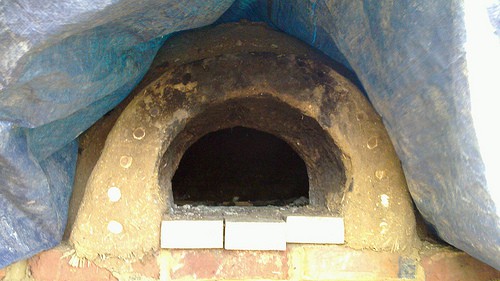
The project at hand, and foot, is the beginning of a cob oven, built exactly the way it would have been built 150 years ago by pioneers in Ontario and Quebec. When we’re done, it will become a summer bake oven for Northern Edge Algonquin, a four-acre eco-retreat located near Algonquin Park, Ontario. Owners Todd and Martha Lucier started it up ten years ago to provide unique experiences in nature. This cob oven is just one of the many projects created by craftsman Greg Waters to enhance the property. He explains that in settlers’ times these summer ovens were used to do a week’s worth of baking and were perfectly suited for the environment and available fuel. The oven is being erected near the settler’s cabin he built with reclaimed logs from the vicinity and will be in symmetry with its rustic surroundings.
The morning slips by and the children gradually disappear, along with my fond childhood memories. Everyone has settled into the task and we’re shuttled cups of lemonade like we’re running a marathon. I look up from my poor, wasted feet to see Waters standing in front of me with a shovel of sand, cheerfully asking if I think it needs more. The soft wet sand piles over my feet and I keep plodding around the vat. He encourages me by saying that we will soon be able to make wood-fired pizza in the cob oven. “All of this work to make a few pizzas?” I joke with another volunteer nearby, “I can get a pizza just by picking up the phone.”
After straw has been added to the clay and sand, we’re ready to cob. Cob simply means “loaf” and we hoist handfuls of clay mixture onto a table and knead it with our hands to get out any remaining air bubbles. Next, we shape it into square loaves about the size of a large loaf of bread. The wet cob is then trundled up the hill to the foundation where they’re pressed together along an alder branch frame in the shape of a dome.
A late afternoon shower makes a mud pit of our mixing vat. It’s time to cover everything up and have a bite to eat. Though I feel thoroughly exhausted, a solar-heated shower sloughs away most of the mud and I fall into a peaceful sleep just after dark. My body has quickly attuned to the natural rhythm of this place.
After our morning coffee, we try to estimate how many loaves it takes to make an oven this size. With an inside area of 42” x 48,” we guess at more than 300 unleavened loaves. Different hands and feet take turns to complete the cobbing, including a brief visit by my six-year-old daughter. She asks me why we’re spending the whole weekend to help build this oven. I smirk and tell her it’s all about pizza, but after reflection I wish I had said—so we never forget how.
With the challenges my daughter will face in the future around energy, water and waste, it is unlikely she will remember how to build a cob oven, but I’ll be sure to keep the recipe to give to her someday.
RECIPE FOR A COB OVEN
- 1 week research (read a book on cob ovens)—1 person
- 1 day site excavation (build a berm)—2 people
- 2 days dry stone foundation, 3’ high, granite and field stone—2 people
- 1 day pouring concrete slab—2 people 1 day making clay “fire rock” and bricking the arch—3 people
- 1 day fire brick 6’x6’ square layer on top of concrete slab—2 people 1 day cob frame, made of alder and tied with wire, wooden arch forms—2 people
- 1 day preparing cob vat and supplies—1 person
- 2 days cobbing to enclose oven—10 people
- 4 weeks to dry
- 1 day building roof structure over top to buffer weather
- 1 week slow baking and vitrifying the clay followed by all the wood-fired pizza you can eat
photo courtesy uniteddiversity (CC- Some rights reserved)

